

A Bible is a physical object with fixed dimensions that directly affect cover fit and usability.
This page explains the Bible only as a physical object that constrains how a Bible cover must be chosen.
It does not explain content, meaning, or editions.
It explains size, structure, and physical behavior only.
Before choosing a Bible cover, it helps to understand one simple thing.
Your Bible is a physical object.
Not an idea.
Not a concept.
A real, printed book with fixed dimensions.
Everything about choosing the right Bible cover starts here.
The Bible As an Object, Not a Concept
For the purpose of this site, the Bible is treated only as a bound book. What matters here is not what the Bible says, but how it exists physically in the real world.
Every Bible has a specific height and width, a certain thickness, a binding and spine structure, and a total weight. These physical traits are not abstract details. They directly decide whether a Bible cover will fit correctly, protect the book properly, and feel comfortable in daily use.
For example, two Bibles with the same name can differ in thickness by over a centimeter due to paper weight or font size.
That difference alone can change whether a cover closes properly.
On its own, a Bible does not protect its pages. It does not make carrying easier. It does not prevent wear from handling, pressure, or movement. That role belongs entirely to the Bible cover.
If you want a full overview of how covers work and why they exist, start with the main Bible cover guide at /.
Why the Bible Matters When Choosing a Cover
A Bible cover must fit the Bible, not the other way around. Even small differences between Bibles can change how a cover performs once the book is inside.
Some Bibles are thicker because of larger font sizes. Others are heavier due to paper quality. Some feel stiffer because of how the binding is constructed. These differences affect how tight a cover feels, whether zippers close smoothly, and how easily the Bible slides in and out during use.
This is why one cover rarely fits every Bible perfectly. Understanding size and fit is not optional. It is the next logical step after understanding the Bible as a physical object. That topic is explained in detail in the Bible size and fit guide at /bible/size/.
When a cover does not match the Bible’s physical form, the result is not just discomfort.
Zippers strain.
Corners bend.
And the cover itself wears faster.
The Bible Creates the Need for Protection
A Bible is opened, closed, carried, set down, and stored repeatedly.
That repeated handling creates friction, pressure, and edge wear over time.
Without a cover, corners bend. Covers scuff. Spines weaken. Pages crease when the Bible is placed in bags, backpacks, or tight spaces. None of this happens because the Bible is poorly made. It happens because books wear down when they are used.
A Bible cover exists to reduce this wear by adding structure, enclosure, and controlled handling. The Bible needs protection. The cover provides it.
How much protection you need depends partly on what the cover is made of. Different materials behave differently over time, which is explained in the material guide.
Not All Bibles Are Physically the Same
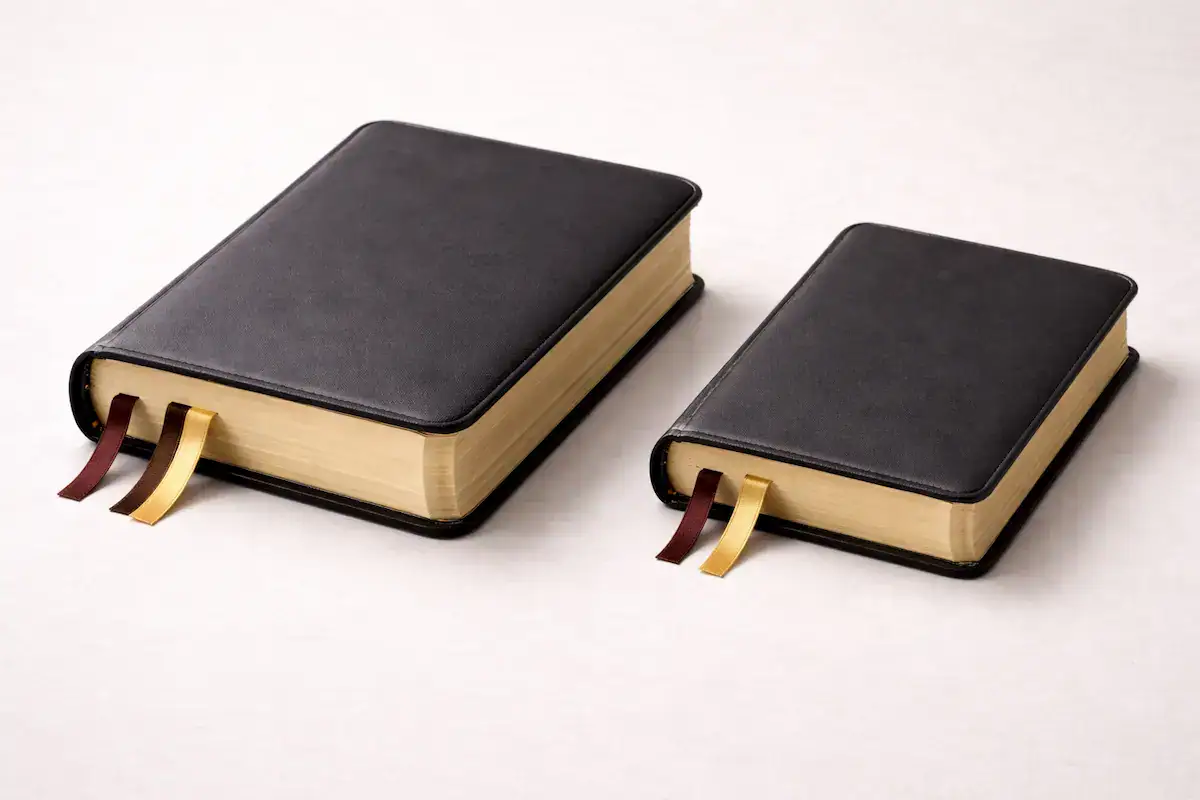
Two Bibles with similar names can still be very different as physical objects.
They can differ in thickness because of paper weight.
They can differ in rigidity because of binding style.
They can differ in weight because of total page count.
This is why choosing a cover based only on a Bible’s name or edition often leads to poor results. Labels do not guarantee fit. Physical dimensions do.
Understanding this removes guesswork and replaces it with practical decision-making.
How the Bible Affects Everyday Use
The shape and thickness of your Bible influence how it feels inside a cover every day. Thicker Bibles can feel cramped in slim covers. Taller Bibles can strain closures if the fit is wrong. Rigid bindings affect how flat the Bible opens when covered.
Over time, these small mismatches change how the Bible feels in your hands.
Not just how it looks on the first day.
This is also why how you use your Bible matters. Reading at home, carrying it daily, or traveling with it all place different demands on the cover. Those situations are explained in the intended use guide.
Common Mistake: Treating All Bibles the Same
One of the most common mistakes is assuming that all Bibles behave the same inside a cover. When this happens, size is guessed instead of checked, covers feel either too tight or too loose, and even good products feel disappointing.
This usually happens when buyers choose a cover based on labels like “standard” or “large print” instead of checking actual dimensions.
Understanding your Bible as a physical object removes this risk before you buy anything.
What to Do Next
Once you understand the Bible as a physical object, guessing stops.
Every next decision becomes measurable.
First, check Bible size and fit.
Next, understand how cover materials behave.
Finally, match the cover to how you actually use your Bible.
Following this order prevents wrong purchases and wasted time.
Frequently Asked Questions
Does every Bible need a cover?
Most Bibles benefit from a cover because they are handled, carried, and stored regularly, which causes wear over time.
Can one Bible cover fit all Bibles?
No. Bible covers must match the Bible’s physical size and thickness. Even small differences can affect fit.
Does the Bible itself provide any protection?
No. A Bible does not protect itself from bending, scuffing, or pressure. Any protection comes entirely from the cover.
Why do two similar Bibles fit differently in the same cover?
Because paper thickness, binding style, and total page count can vary even between similar editions.