
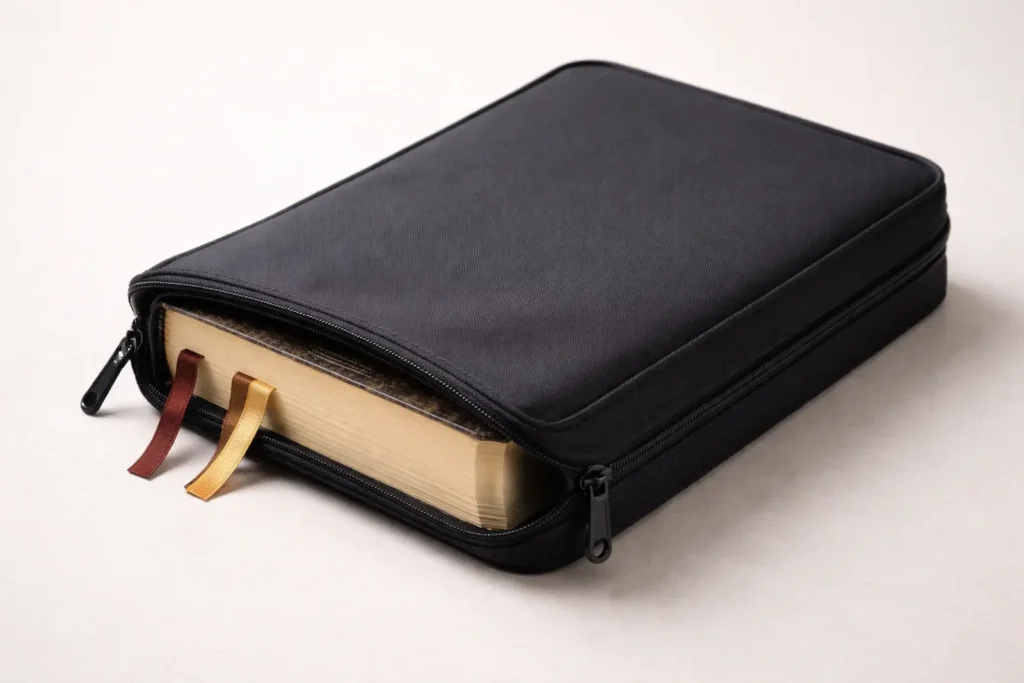
This page defines what a Bible cover is, how it functions, and how to think about choosing one. It does not recommend specific products.
What A Bible Cover Is
A Bible cover is a protective product made to enclose a Bible and help it hold up during storage and transport.
It exists for one simple reason. A Bible is a real, physical object. It has weight, thickness, edges, and a binding that wears down faster when it is carried often or handled daily.
A Bible cover is designed around that reality. It protects the book and makes it easier to carry and use without turning the Bible into something bulky or awkward.
This page explains Bible covers as a category, not specific types, sizes, or buying options.
This distinction becomes clearer when you understand how a Bible differs physically from other books.
What A Bible Cover Is Not
A Bible cover is not the Bible itself. It does not change the content, structure, or meaning of the book.
A Bible cover is not defined by appearance. While some covers are more decorative than others, aesthetics are secondary to function.
It is also not a generic book sleeve. Many book sleeves are not built around the size patterns, thickness variations, and frequent handling that are common with Bibles.
What Actually Matters When Choosing A Bible Cover
A Bible cover only works when it matches real constraints and real use.
Without a clear understanding of what a Bible cover is meant to do, advice about size, material, and use loses context and becomes harder to apply.
Most good decisions come down to a small number of connected factors.
The Bible itself matters first, because it is a physical object with fixed dimensions.
Size and fit compatibility come next, because a cover can only work if the Bible fits correctly.
Material then determines durability, protection, and weight over time.
Finally, real-world use defines which trade-offs matter most.
Everything else is secondary.
Size Comes First
A Bible cover exists to protect and carry a Bible, and its effectiveness depends entirely on the Bible’s physical properties.
That is why the Bible is not a background detail in this decision. The Bible sets the limits a cover must satisfy. Height, width, thickness, and even binding style can determine whether a cover fits cleanly or fights you every time you open it.
When the fit is wrong, the cover cannot do its job well. A tight fit can stress seams and corners, while a loose fit can leave edges exposed and allow the Bible to move inside the cover, increasing wear during transport.
Material Changes How A Bible Cover Holds Up
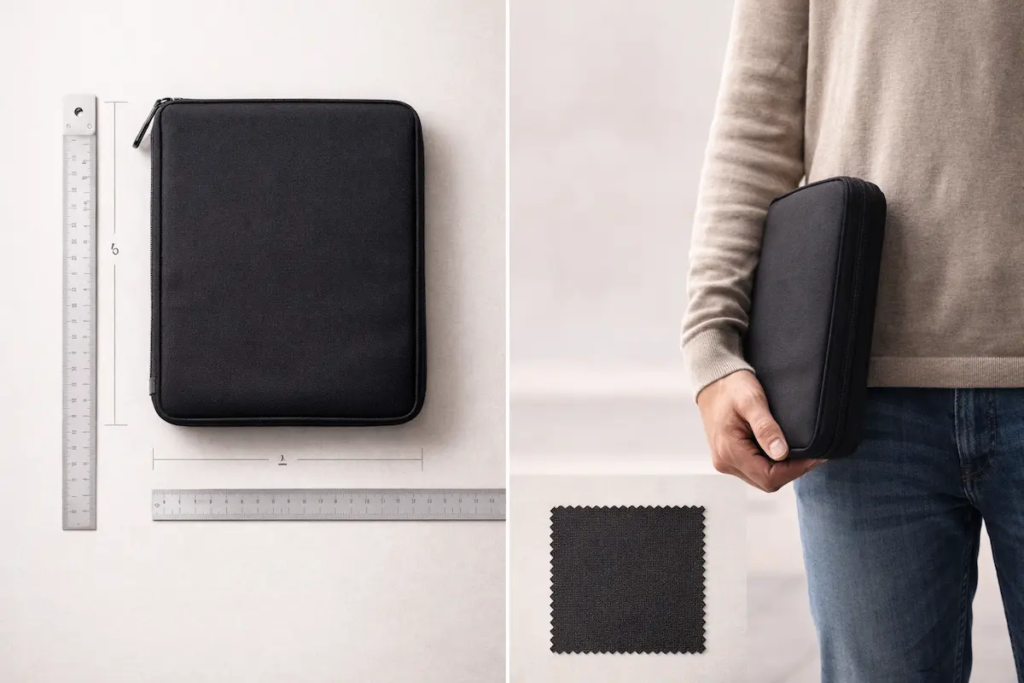
A Bible cover is handled, carried, set down, and moved through daily life. It may rub against surfaces, get squeezed in a bag, or deal with moisture and temperature changes.
Material affects how durable a Bible cover is under repeated handling.
Material also influences how much physical protection the cover provides against impact, pressure, and abrasion.
In addition, material affects weight, which changes how the Bible feels during daily use.
This is about physical behavior, not style.
Some materials resist scuffs better. Some absorb impact better.
Others add noticeable weight and change how the Bible feels in your hands.
See how material affects durability, protection, and weight (picture above)
Intended Use Changes The Trade-Offs
A cover that stays mostly at home does not face the same demands as a cover that travels daily.
Use context decides what matters most. When you carry your Bible often, portability and ease of access tend to matter more. When the Bible is exposed to rough handling, protection becomes more important. When notes or small items are carried alongside the Bible, storage features start to matter more.
There is no “best” cover in the abstract. There is only the best match for how you will actually use it.
Practical Implications
A Bible cover influences how safely, comfortably, and consistently a Bible can be carried and used.
When a Bible cover fits correctly and uses the right material, it reduces wear on corners, edges, and binding.
When a cover does not match the Bible or its use, wear increases faster and the cover becomes frustrating to use.
When a Bible cover is misunderstood, the result is predictable. The fit may be poor, protection may be reduced, and unnecessary wear appears sooner than expected.
Many “bad covers” are not bad products. They are simply bad matches for the Bible or the way it is used.
Where To Go Next
Bible covers are not interchangeable accessories. They exist because Bibles are used, carried, and handled differently depending on size, material, and context.
To choose confidently, follow the same order the decision follows.
First, understand the Bible as a physical object.
Then handle size and fit compatibility.
Then learn how material behaves over time.
Finally, choose based on real use scenarios.