

Before you look at materials, pockets, or carrying styles, there is one decision you cannot skip.
Bible size.
If the size is wrong, nothing else matters. A Bible cover only works if your Bible physically fits inside it.
What “Bible Size” Actually Means
Bible size refers to the physical dimensions of your Bible as an object.
It includes the height of the Bible.
It includes the width of the Bible.
It includes the thickness created by pages and binding.
These three measurements define whether a Bible cover can close properly, protect the book evenly, and feel comfortable in everyday use.
Bible size is not a label. It is not a name, and it is not a category. It is a physical constraint.
This builds directly on the idea explained in the Bible as a physical object guide at /bible/.
To determine your Bible size, you must look at the Bible itself.
Measure the height from top to bottom, the width from side to side, and the thickness across the spine while the Bible is fully closed.
These physical dimensions are what a cover must accommodate, not the Bible’s title or edition name.
Why Bible Size Is the First Decision That Matters
A Bible cover does not stretch or adapt to the book inside it. The cover is built with fixed dimensions, just like the Bible itself.
If a Bible is too tall, the cover may not close properly.
If the Bible is too thick, closures operate under constant strain.
If the Bible is too small, the cover cannot hold it securely.
When size is ignored, the cover fails at a basic functional level. Bible size determines whether a cover can work as intended at all.
When size is ignored, people often assume the cover is poor quality. In reality, the problem is usually fit. Bible size determines whether a cover can function at all.
Are All Bibles the Same Size?
No. Even Bibles that look similar can differ physically in meaningful ways.
Differences often come from font size, paper thickness, total number of pages, and binding style. Two Bibles with the same name can still vary in thickness or height, especially when comparing standard editions to large-print or study versions.
This is why choosing a cover based only on a Bible’s title or edition often leads to poor results. Physical fit always matters more than naming.
What Happens When the Fit Is Wrong
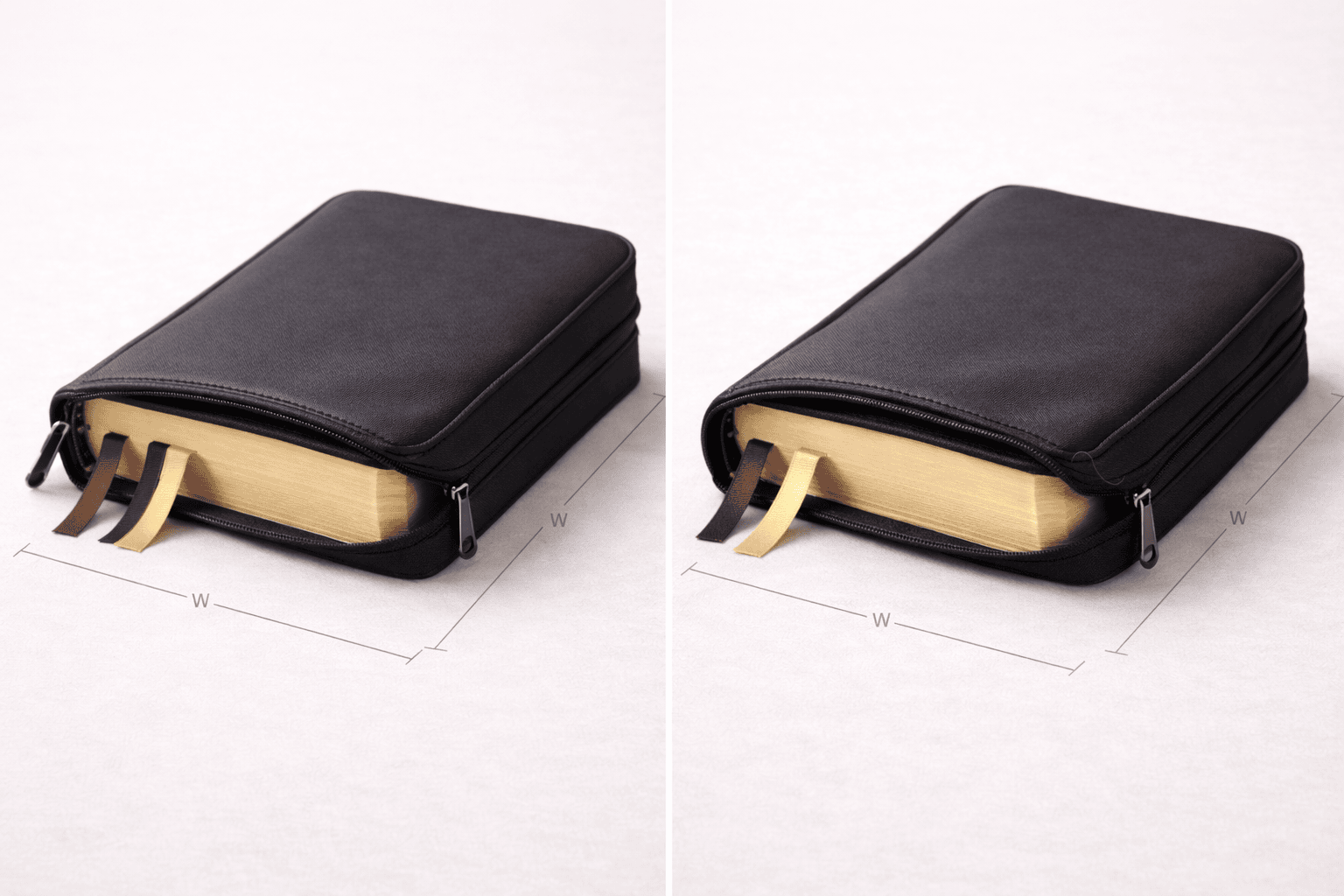
When Bible size and cover size do not match, problems appear quickly.
A small amount of extra internal space is usually manageable, but significant looseness or tightness leads to reduced protection and faster wear. The goal is stable enclosure without compression or shifting.
The Bible may be difficult to insert or remove.
The cover may feel tight and rigid instead of supportive.
Zippers and closures may experience constant stress.
Over time, protection becomes uneven and less reliable.
A poor fit affects both durability and daily comfort. Correct sizing prevents these issues before they start.
How Bible Size Affects Protection
A Bible cover protects the book by distributing pressure evenly and keeping the Bible stable inside the cover.
If the Bible is too loose, the cover cannot maintain consistent contact. If the Bible is too tight, materials are forced to operate under compression, which accelerates stress on seams and closures.
Proper size allows the cover to protect evenly, without strain and without gaps.
Bible Size vs. Cover Material
Bible size and cover material work together, but size always comes first.
A thicker Bible paired with a rigid material can feel stiff and uncomfortable if sizing is not correct. A slimmer Bible placed in a softer material may still feel loose if the cover is oversized.
Material behavior is explained in detail in the cover material guide. However, material choice only makes sense after size is confirmed.
Bible Size and Everyday Use
How you use your Bible determines how noticeable fit problems become.
With frequent carrying, small size mismatches quickly turn into discomfort, handling friction, and faster wear. Occasional use may mask these issues, but it does not eliminate them.
Real-world usage scenarios are explained in the intended use guide.
Common Mistake: Guessing the Size
One of the most common mistakes is assuming Bible size.
This assumption is often based on the Bible’s name.
It is also based on general categories.
Previous covers that fit other Bibles are another common reference point.
This often leads to returns, frustration, and wasted time. Bible size should be treated as a decision checkpoint, not an afterthought. Once size is clear, the rest of the selection process becomes simpler and safer.
What to Do After You Know Your Bible Size
When Bible size is understood and confirmed, you can move forward with confidence.
At that point, choosing a suitable material makes sense. Matching the cover to how you use your Bible becomes easier. Selecting features that support comfort and protection becomes straightforward.
All of these decisions depend on correct sizing first. Once fit is confirmed, material choice and intended use determine how the cover performs in real life.
Frequently Asked Questions
Why doesn’t my Bible fit a standard Bible cover?
Because Bibles vary in height and thickness, even within similar editions. Covers must match physical dimensions, not labels.
Can a Bible cover be slightly bigger than my Bible?
A small amount of extra space is usually acceptable, but too much room reduces protection and allows the Bible to shift.
Is thickness more important than height or width?
Thickness is often the most overlooked factor and a common cause of poor fit, especially with large-print or study Bibles.
Does binding style affect Bible size?
Yes. Rigid bindings and thicker spines can change how a Bible fits and opens inside a cover.